
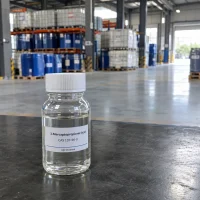
3-Mercaptopropionic Acid CAS 107-96-0
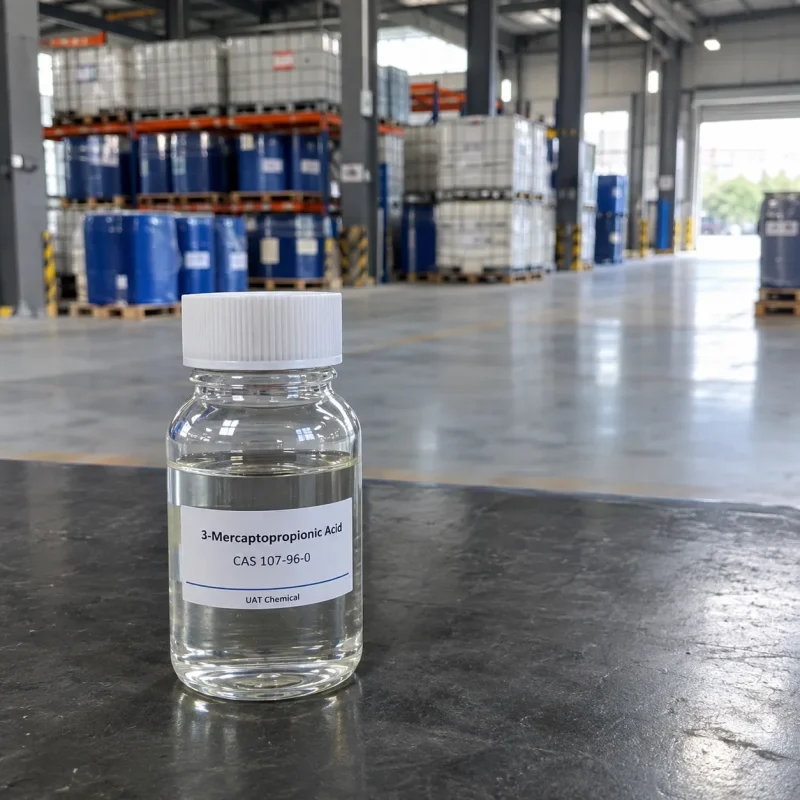
3-Mercaptopropionic Acid, shortened to 3-MPA, is a small sulfur-bearing molecule that carries both a thiol and a carboxylic acid group, so it reacts from both ends in synthesis. It is a clear, colorless to pale-yellow liquid with a sharp sulfide smell, soluble in water, and it thickens or partly crystallizes below about 17 °C before clearing again on gentle warming. Polymer makers value the thiol end as a chain-transfer agent that sets molecular weight, while the acid end is esterified into PVC tin heat stabilizers. UATChem holds the standard industrial grade as a sealed liquid in drums and IBCs, matching assay and color to each process, with a COA and a route-specific SDS for every consignment.
- CAS: 107-96-0
- EC Number: 203-537-0
- Synonyms: 3-MPA; beta-mercaptopropionic acid; 3-thiolpropanoic acid
- Molecular Formula: C₃H₆O₂S (HSCH₂CH₂COOH)
- Molecular Weight: 106.14
- Appearance: Clear colorless to pale-yellow liquid, sulfide odor
- Assay and Color: Industrial grade; assay and Hazen color reported on COA
- Density (25 °C): about 1.218 g/mL
- Refractive Index (20 °C): about 1.492
- Melting Point: about 15 to 18 °C
- Flash Point: about 93 °C (closed cup)
- Solubility: Soluble in water and ethanol
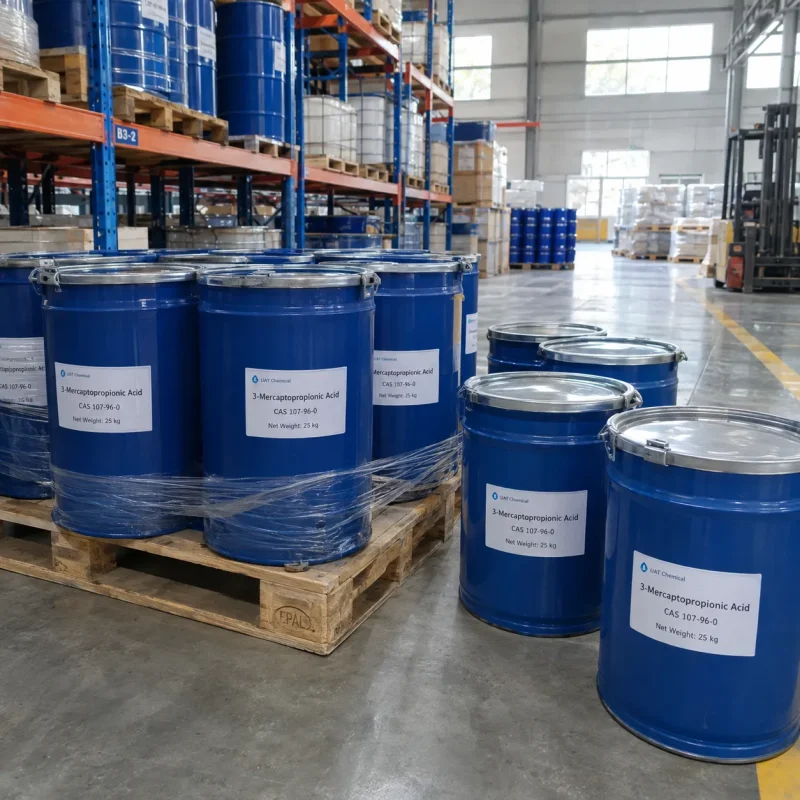
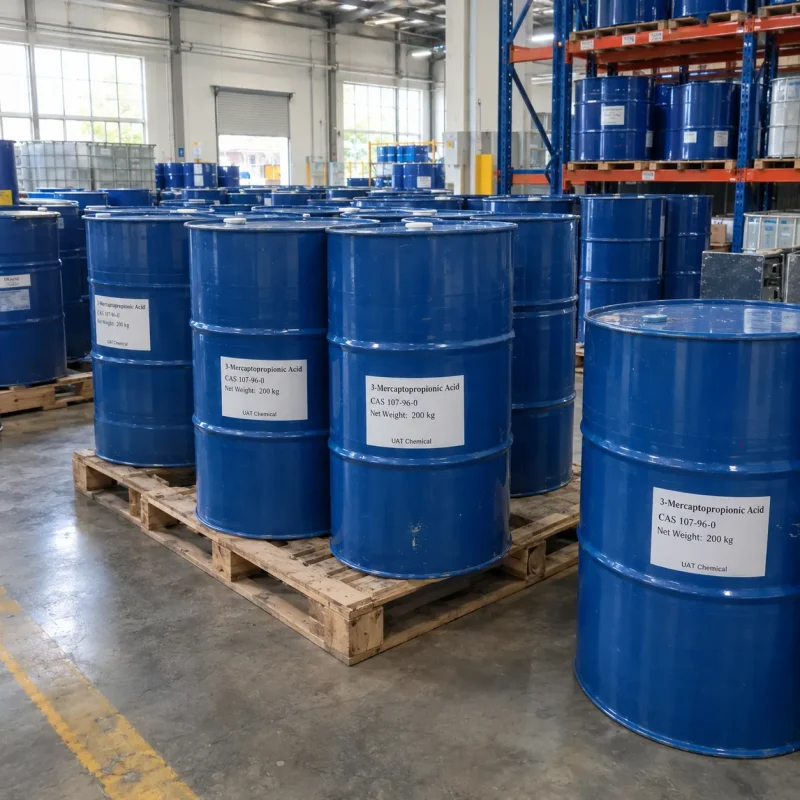
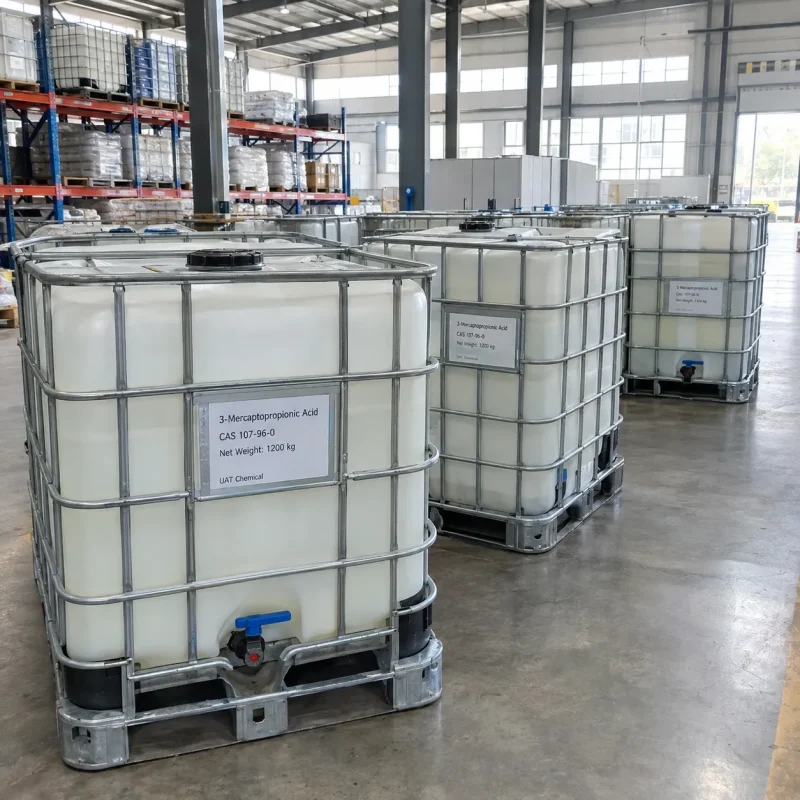
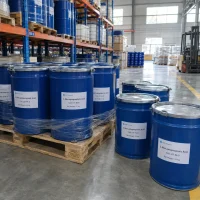
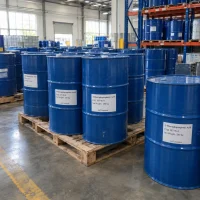
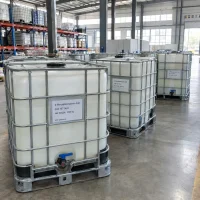
- Packaging: 25/30 kg drum; 250 kg drum; 1000/1200 kg IBC
About 3-Mercaptopropionic Acid
3-Mercaptopropionic acid is a three-carbon acid with a thiol group on the end carbon, a simple structure that gives two reactive handles in one molecule. The thiol end terminates growing polymer chains in a controlled way, and the carboxylic acid end esterifies with alcohols the way an ordinary acid does. In practice quality tends to be judged on assay, Hazen color, water and sulfur impurities, because a pale, clean, low-odor lot gives lighter polymers and clearer stabilizers. The liquid is air sensitive and hygroscopic and carries a clinging sulfide odor, so drums stay sealed, sometimes under nitrogen, and are opened only under ventilation.
What 3-MPA Does in Production
Polycarboxylate superplasticizers. This is the largest single outlet. When TPEG or HPEG polyether macromonomers are copolymerized with acrylic acid, a small, metered feed of 3-MPA acts as the chain-transfer agent that fixes polymer molecular weight, which tunes the water reduction and slump retention of the finished concrete admixture.
PVC tin heat stabilizers. The acid is esterified, commonly with 2-ethylhexanol, into isooctyl mercaptopropionate, the sulfur ligand used to build methyltin and other organotin heat stabilizers for clear and transparent PVC compounds.
Other outlets. Smaller volumes go into pharmaceutical and fine-chemical synthesis, electronic adhesives and nanoparticle capping, UV-cured acrylate chain control, epoxy and coating modifiers, and depilatory or hair-waving reducing formulations where a thiol close to thioglycolic acid is wanted.
Grades, Specifications and Packing
Industrial export lots run as a high-assay liquid; the exact assay, Hazen color, water and acidity are printed on each COA rather than guessed from a generic sheet.
| Parameter | Value |
|---|---|
| Appearance | Clear colorless to pale-yellow liquid |
| Grade | Industrial, high-assay liquid |
| Molecular Weight | 106.14 |
| Density (25 °C) | about 1.218 g/mL |
| Refractive Index (20 °C) | about 1.492 |
| Melting Point | about 15 to 18 °C |
| Flash Point | about 93 °C (closed cup) |
| Assay and Color | Reported on each COA |
| Solubility | Soluble in water and ethanol |
Packing is built around keeping the odor in and the air out: 25 kg and 30 kg HDPE drums, 250 kg steel or plastic-lined drums, and 1000 kg to 1200 kg IBCs. Neutral marking and nitrogen-blanketed IBCs can be arranged for repeat orders.
Handling, Storage and Transport
- The liquid is corrosive and burns skin and eyes, and the vapors irritate airways, so wear goggles, gloves and protective clothing and work under ventilation or local extraction.
- Keep containers tightly closed away from strong oxidizers, bases and open air, because the sulfide odor spreads quickly and the liquid picks up moisture on exposure.
- Store below about 30 °C and out of sunlight. Stock that thickens or crystallizes near the 17 °C melting point clears again after gentle, even warming and can be used normally.
- It moves as a corrosive dangerous good under the class and packing group shown on the route SDS; COA and SDS are sent ahead of shipment so booking and customs papers are ready.
Questions Before You Order
Q: What assay and color can we expect?
A: Industrial export material is a high-assay, pale liquid, and the exact assay and Hazen color are stated on each batch COA.
Q: Does it freeze in winter?
A: It may thicken or partly crystallize near 15 to 18 °C; gentle warming restores a clear liquid with no performance loss.
Q: How is it packed and what paperwork comes with it?
A: It ships sealed in 25 kg or 30 kg drums, 250 kg drums and 1000 kg or 1200 kg IBCs, with COA and a route-specific SDS.
Related products
Ready to Source? Talk to Our Engineers
Industrial Chemical Raw Materials, Factory-Direct — Quote Within 1 Hour
Stable high-purity supply, flexible packaging and complete compliance documentation for your formulations — exporting worldwide since 2006.
- 1000+Products
- 200+QC Protocols
- 7–15Days Delivery
- Factory-Direct Pricing
- COA / TDS / SDS Included
- Free Samples for Testing
- ISO 9001 Certified